
.png&w=3840&q=75&dpl=dpl_7QBQJPp8YaFXTRtPdcTKMTbKM4AS)
Walk into any growing builder’s office on a Monday morning.
Sales is working out of one CRM. Finance is tracking collections in a spreadsheet that lives on someone’s laptop. Post-sales is running on three WhatsApp groups. Brokers are coordinating through phone calls and a separate shared sheet. Inventory sits in a fourth tool nobody touched since the last launch. The management report is being assembled by hand for the 10 AM review.
Everyone is working. Nobody is slacking. The numbers, somehow, are moving in roughly the right direction.
And yet growth keeps slowing. Not because demand has dried up. Because the operation itself is starting to bend under its own weight.
Why this matters: Most builders never plan their software stack. It accumulates one tool at a time, over years. The cost of that accumulation rarely shows up on any line item until growth itself starts to plateau.
This is what Briqhaus is built around. Not another CRM bolted onto the existing chaos, but a centralised operating system for real estate builders, connecting lead management, collections, inventory, finance, buyer lifecycle, post-sales workflows, channel partner management, and AI automation on one platform.
One system. One source of truth. Built for the way Indian real estate actually works.
Here’s what we’ll cover: Why fragmented tools quietly slow builders down. Where the operational leakage actually happens. Why Excel and disconnected CRMs stop scaling. What a centralised operating system changes. And how Briqhaus connects the entire builder workflow.
The problem isn’t software. It’s disconnected software.
Most builders accumulate operational layers without ever consciously designing them. A typical growing developer is running:
- One CRM for leads
- nother tool for accounting
- preadsheets for collections
- WhatsApp for broker coordination
- Email for approvals
- A manual report someone assembles every Monday morning
Individually, none of these is broken. Each one was reasonable when it got added.
But every handoff between them is a manual job. Someone updates data. Someone else verifies it. A third person follows up. A fourth person reconciles the mismatches.
At 20 bookings, this is annoying. At 500 buyers across multiple towers and projects, it’s expensive.
Where operational leakage actually happens
The dangerous part of running on fragmented systems is that failure is rarely dramatic. Revenue doesn’t disappear overnight. The team doesn’t suddenly collapse. The numbers keep moving.
But operational efficiency erodes quietly. Follow-ups slow. Collections drift. Approvals stack up. Reports become inconsistent. Teams spend more of their day coordinating than executing.
The business keeps running. It just runs worse.
Sales teams stop trusting the CRM
This usually starts in sales. Leads are coming in from portals, paid campaigns, brokers, exhibitions, walk-ins, referrals, WhatsApp enquiries.
If the CRM doesn’t actually reflect how the sales team works , which it usually doesn’t, because most CRMs weren’t designed for Indian real estate ,important communication moves outside it. Notes shift to WhatsApp. Follow-ups go into personal reminders. Site visits get coordinated over calls. Excel becomes the unofficial backup.
The CRM slowly turns into a reporting tool. Management pulls numbers out of it. Nobody actually runs the business on it.
AI gets useful only when the data is centralised

A lot of companies talk about AI in real estate. Most of it is theatre, because AI can only do useful work on top of structured operational data. If collections sit in spreadsheets, follow-ups sit in WhatsApp, and inventory sits in a third tool, there is no foundation for AI to operate on.
Because the whole workflow lives on one platform, the AI can actually do operationally meaningful things ,surface delayed collections, prioritise high-risk accounts, identify workflow bottlenecks, improve visibility. Not cosmetic dashboards. Actual operating leverage.
Finance builds its own parallel layer
Most finance teams end up building their own operational system, because the sales stack doesn’t support collections properly. Demand letters get tracked in a separate sheet. Outstanding calculations happen manually at month-end. Buyer dues are maintained in spreadsheets one finance executive owns. GST and TDS reconciliation gets layered into a process that takes a week.
What emerges is a parallel operating structure , one for sales, one for finance, one for post-sales , none of which are talking to the others. This is where operational duplication becomes genuinely expensive.
Post-sales become a coordination problem
The booking is not the end of the buyer journey. In Indian real estate, the next two to four years involve payment schedules, construction-linked demands, GST, TDS, agreement tracking, refunds, possession, support, society handover.
In a fragmented setup, post-sales teams inherit incomplete data. The buyer who booked the apartment lives in one system; the buyer requesting a possession update lives in another. Teams spend their day looking up records and reconciling communication, instead of actually improving buyer experience.
Excel becomes the bridge that collapses
No real estate company sets out to run its operations on Excel. Excel becomes the bridge because the systems underneath don’t talk to each other. Someone exports from the CRM. Someone else exports from accounting. A third person combines both manually.
For a while, this works. At small scale, spreadsheets are flexible. At scale, they’re fragile. One wrong formula, one stale version, one missed update and collections, reporting, inventory, and buyer communication all take the hit.
Why builders need one centralised operating system
Real estate operations are deeply interconnected. Sales affects collections. Collections affect finance. Finance affects project execution. Project execution affects buyer communication. Buyer communication affects brand reputation.
Disconnected tools force these workflows apart. A centralised operating system reconnects them , not by adding integrations on top of the old stack, but by running the whole workflow in one place.
What changes when the system is centralised

The biggest shift isn’t automation. It’s visibility.
When the entire buyer lifecycle runs on one platform, everyone is working from the same data. Every team sees the same status. Decisions happen in real time, not after Monday morning’s compilation. The organisation stops depending on memory, follow-up calls, and reconciliation work to keep itself together.
One buyer record from lead to possession
On Briqhaus, the buyer who first submitted a lead form and the buyer collecting possession years later are the same record. Lead source, every site visit, the inventory selection, payment schedules, collections, demand letters, support tickets, possession workflows , all attached to one entity. Nothing fragments between departments.
Inventory, CRM, collections, and finance run together
Sales teams see live inventory, unit status, payment progress, and buyer communication history. Finance teams see collections, dues, TDS, GST, allocation status. Management sees project-level visibility, collections forecasts, sales velocity, and operational bottlenecks , through one dashboard, not five reports stitched together on a Sunday night.
Workflow automation replaces individual dependency
One of the biggest risks in real estate operations is dependency on individuals. When workflows depend on memory and personal tracking, the operation is one resignation away from chaos.
Briqhaus automates lead assignments, follow-up reminders, demand letters, payment notifications, approval flows, buyer communication, and collections tracking , so the workflow is run by the system, not by the people who happen to be in the office that week.
WhatsApp becomes operational, not chaotic
WhatsApp is already the unofficial operating layer in most builder organisations. The problem is that information inside personal chats isn’t searchable, isn’t structured, and isn’t visible to management.
Briqhaus brings WhatsApp into the workflow. Reminders, demand notifications, acknowledgements , all attached to the buyer record, all logged. Communication stays trackable instead of scattered.
Before vs. after
Easiest way to see the change:
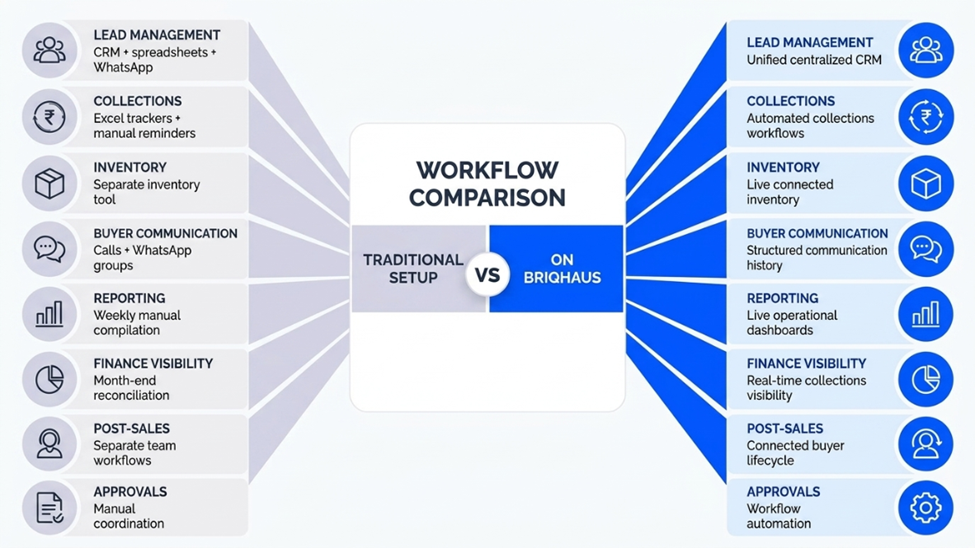
Most builders don’t experience one dramatic operational breakthrough after centralisation. They experience fewer delays, cleaner reporting, faster coordination, better buyer visibility, and dramatically less operational friction. The compounding effect over a year is what changes the business.
What this means for management teams
Better operational control
Management stops relying on verbal updates, department-by-department coordination, and Monday-morning spreadsheet summaries. Visibility becomes live. The speed of decision-making changes accordingly.
Better forecasting
When collections, sales, inventory, and finance all live in one system, forecasting starts to mean something. Cash flow becomes predictable. Project planning gets cleaner. Operational surprises go down.
Teams stop working reactively
Most fragmented organisations operate reactively , solving problems after they appear. A centralised system lets teams spot bottlenecks early, automate the repetitive work, and manage workflows proactively. The difference in execution quality shows up within weeks.
The bottom line
Most builders don’t lose operational efficiency because their teams aren’t trying. They lose it because disconnected systems create invisible friction at every handoff.
A CRM doesn’t fix this. Neither does accounting software. Neither does another spreadsheet.
What real estate operations actually need is one workflow, one buyer lifecycle, one operational source of truth. That’s what a centralised operating system gives you.
Briqhaus is built for that, not as another tool added to the stack, but as the operational layer that runs CRM, collections, finance, inventory, post-sales, channel partners, and buyer lifecycle workflows from one place, designed specifically for the way Indian builders actually operate.
Stop scaling disconnected operations. Book a 20-minute Briqhaus walkthrough and see what real estate operations look like once your entire workflow runs from one centralised operating system.